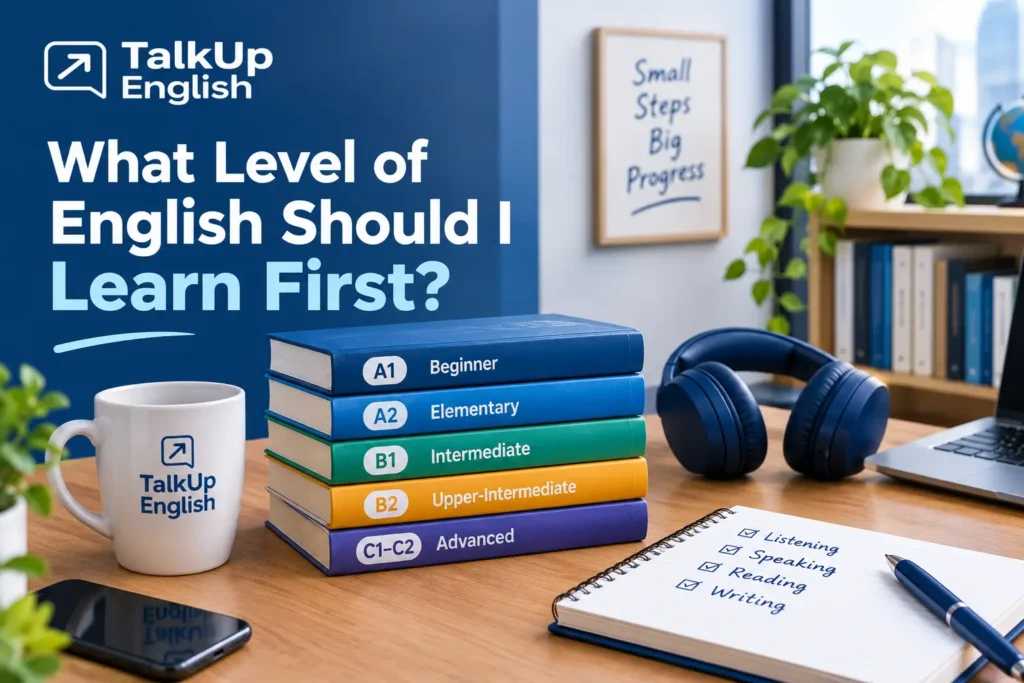
If you are starting English, A1 is the correct first level for a complete beginner. The Common European Framework of Reference for Languages (CEFR) places A1 at the beginning of the six-level scale from A1 to C2. A1 focuses on basic vocabulary, simple grammar, everyday expressions, and essential communication. Starting at the correct level prevents gaps in foundational skills and gives you a clear path toward A2, B1, B2, C1, and C2. A clear starting point makes study efficient and helps you choose suitable materials from the beginning.
What Is the CEFR English Level System?
The CEFR is a framework that describes what you can do in a language at different stages of proficiency. CEFR levels cover listening, speaking, reading, and writing, so an English level reflects practical communication ability rather than vocabulary knowledge alone.
The six levels are A1, A2, B1, B2, C1, and C2. A1 and A2 represent basic users, B1 and B2 represent independent users, and C1 and C2 represent proficient users. Each level has specific communication expectations.
Your current English level does not depend only on how many words you know. A learner may recognise advanced vocabulary but still struggle with basic speaking or listening. A proper assessment considers multiple skills before recommending an English course.
What English Level Is Best for Beginners?
A1 is the best English level for complete beginners because A1 establishes the language foundations required for everyday communication. A1 learners focus on greetings, introductions, numbers, colours, family, food, common objects, simple questions, and essential verbs.
A1 grammar commonly includes the verb “to be,” basic pronouns, articles, simple present structures, basic questions, negatives, possessives, and common prepositions. A1 learners build enough vocabulary to communicate simple personal information and understand familiar expressions.
A complete beginner should not skip A1 simply because A1 content looks easy. Strong foundations make later grammar, vocabulary, pronunciation, and listening practice easier to manage.
What Should You Learn at A1?
At A1, learn practical English that helps you understand and produce short, simple messages. Your study should cover four core skills: speaking, listening, reading, and writing.
Focus on these areas:
- Basic greetings, introductions, and personal information
- Numbers, dates, time, prices, and common measurements
- Family, home, food, shopping, transport, and daily routines
- Common verbs such as be, have, do, go, like, want, and need
- Simple present sentences and basic question forms
- Essential pronunciation and alphabet sounds
- Short messages, forms, notices, and simple descriptions
A1 study should prioritise accuracy and practical communication. You do not need complex grammar before you can introduce yourself, ask simple questions, understand basic instructions, or describe familiar subjects.
What Comes After A1?
A2 is the next English level after A1 and expands your ability to communicate about familiar daily situations. A2 learners can discuss routines, shopping, travel, family, work, preferences, and simple experiences with greater independence.
At A2, you develop longer sentences, broader vocabulary, stronger listening comprehension, and more reliable grammar. You begin to handle short conversations and simple written texts without depending on translation for every sentence.
The transition from A1 to A2 should strengthen the basics rather than replace them. Continue reviewing core verbs, sentence structures, pronunciation, and everyday vocabulary while adding more complex language.
What Do B1 and B2 Mean?
B1 marks the intermediate stage, while B2 represents upper-intermediate English with greater independence and range. B1 learners can handle many travel and daily-life situations, discuss familiar subjects, write straightforward messages, and understand the main points of clear conversations.
B2 learners can communicate more clearly across a wider range of topics. B2 study usually develops fluency, vocabulary range, writing structure, listening comprehension, and more accurate grammar. Learners may start preparing for academic, professional, or exam-specific communication at this stage.
Your learning goal matters when choosing a course at B1 or B2. General English may suit everyday communication, while specialised preparation can address workplace communication or an International English Language Testing System (IELTS) target.
What Do C1 and C2 Mean?
C1 and C2 are advanced proficiency levels for learners who can communicate with substantial control and precision. C1 learners can understand complex texts, participate confidently in discussions, and produce detailed written communication for academic or professional contexts.
C2 is the highest CEFR level. C2 learners can understand almost everything encountered in normal communication and express ideas with high precision. Study at C2 often focuses on specialised vocabulary, style, register, academic writing, professional communication, and subtle differences in meaning.
A beginner should not select C1 or C2 material as a starting level. Advanced resources can provide useful exposure, but foundational learners need language that matches current ability.
How Do You Know Your English Level?
The most reliable way to identify your English level is to combine a level test with a speaking assessment. A written test can measure grammar, vocabulary, reading, and sometimes listening, while a speaking check reveals how effectively you communicate in real time.
Placement tests help schools recommend an appropriate class. A test result should not become the only measure of ability because English skills can develop at different rates. A learner may have stronger reading skills than speaking skills, for example.
Before choosing an English course, complete a reputable level assessment and examine your results across speaking, listening, reading, and writing. This approach gives you a more useful picture of your current ability.
Should You Start at A1 or A2?
Start at A1 if you have little or no practical English ability; start at A2 if you can already communicate basic information and understand simple everyday English. Your starting point should reflect demonstrated ability rather than the amount of English you studied previously.
You may know basic grammar rules but still need A1 speaking and listening practice. Another learner may understand simple conversations comfortably and therefore benefit more from A2 content.
A placement test can help resolve uncertainty. Avoid choosing a level solely because the label sounds familiar or because you want to progress faster.
How Can You Improve From Beginner Level?
You can improve from beginner level by combining structured lessons with daily practice across speaking, listening, reading, and writing. A beginner needs repeated contact with core vocabulary and sentence patterns before advanced material becomes useful.
Use a simple weekly routine. Study new vocabulary, practise short conversations, listen to beginner-level English, read short texts, and write simple sentences. Speak aloud instead of completing every exercise silently.
An English course for beginners can provide structured lessons, progressive grammar practice, guided speaking activities, and feedback. Talkup English can support learners who need a clear starting point and a structured route toward higher proficiency.
How Long Does It Take to Move Up One Level?
The time required to move up one CEFR level varies according to your starting ability, study time, practice quality, attendance, and exposure to English. No single number of weeks applies to every learner.
Consistent practice usually supports stronger progress than irregular study. Your results depend on how actively you use English outside lessons, how often you receive corrections, and whether your study addresses weaker skills.
Track progress through practical outcomes rather than time alone. Measure whether you can understand longer conversations, use broader vocabulary, write clearer texts, and speak with greater accuracy and confidence.
Which English Level Do You Need for IELTS?
IELTS preparation depends on your current English level and target score, so an IELTS course should match both factors. Many learners begin focused IELTS preparation around B1 or B2, but requirements vary according to the target score and test purpose.
IELTS measures listening, reading, writing, and speaking. General English development can strengthen those underlying skills, while dedicated IELTS preparation adds test-specific strategies, task practice, timing, and assessment criteria.
Do not choose IELTS preparation solely because you want an English certificate. Establish your current level first, then select preparation that addresses the gap between your present ability and target result.
When Should You Move to an Advanced English Course?
You are ready for advanced-level study when you can communicate independently and handle complex English with relatively strong accuracy. C1-level learners can discuss abstract topics, understand detailed information, write structured texts, and adapt language to academic or professional contexts.
An advanced level English course is appropriate when basic and intermediate structures no longer represent your main learning needs. Advanced study can focus on precision, sophisticated vocabulary, professional communication, complex grammar, writing style, and nuanced comprehension.
A level assessment remains useful before moving upward. Strong progress does not require rushing through levels because each stage develops skills needed for more demanding communication.
What Course Do You Need at Each Level?
The right English course depends on your level and communication goal. General English suits learners who want balanced development across everyday speaking, listening, reading, and writing.
A practical course pathway looks like this:
- A1: Beginner English foundations
- A2: Elementary everyday communication
- B1: Intermediate independent communication
- B2: Upper-intermediate fluency and range
- C1: Advanced academic or professional communication
- C2: Proficiency and specialised language refinement
Your objective can change the course choice. General English supports broad communication, IELTS preparation supports an exam target, and English for work focuses on professional situations such as meetings, emails, presentations, and workplace vocabulary.
Can You Skip an English Level?
Yes, you can sometimes enter above A1 when an assessment demonstrates that you already possess the required skills. A learner does not need to complete every level if current ability matches the learning outcomes of a higher stage.
Skipping a level should not mean skipping essential knowledge. A placement assessment can identify gaps that require targeted revision before you move forward.
Do not skip A1 merely because you recognise basic vocabulary. Check whether you can use foundational grammar, understand simple spoken English, answer basic questions, and produce accurate sentences.
A Simple English Level Roadmap
A1 builds foundations, A2 develops everyday independence, B1 strengthens practical communication, B2 expands fluency and range, C1 develops advanced control, and C2 refines high-level proficiency. Each stage builds on the communication skills established at earlier levels.
Use the roadmap to identify your next learning target rather than trying to master every English feature immediately. A clear progression makes course selection easier and helps you choose study materials that match your current ability.
Your first priority is accurate placement. Once your level is clear, select lessons that address current weaknesses and practise English consistently across all four skills.
Frequently Asked Questions
What English level is best for beginners?
A1 is the best English level for complete beginners because A1 teaches essential vocabulary, basic grammar, pronunciation, and simple communication. A1 learners build foundations before progressing to A2, where learners handle broader everyday topics with greater independence and longer sentences.
What should a beginner learn first in English?
A beginner should first learn basic pronunciation, greetings, personal information, common vocabulary, simple verbs, and essential sentence structures. Early lessons should cover practical topics such as family, food, numbers, time, daily routines, and simple questions used in everyday communication.
How can I improve my English from beginner level?
You can improve beginner English through structured lessons and regular practice in speaking, listening, reading, and writing. Study essential vocabulary, practise basic grammar, listen to simple English daily, speak aloud, write short sentences, and receive feedback on recurring errors.
How long does it take to reach an intermediate English level?
Reaching intermediate English takes different amounts of time because progress depends on study frequency, starting ability, practice quality, and exposure. Consistent lessons and regular practice can support progress, but learners should measure development through communication ability rather than a fixed timetable.
How can I test my English level as a beginner?
You can test your English level with a reputable online assessment followed by a speaking check. A useful level test examines grammar, vocabulary, reading, and listening, while speaking assessment shows whether your practical communication matches the expected CEFR level.