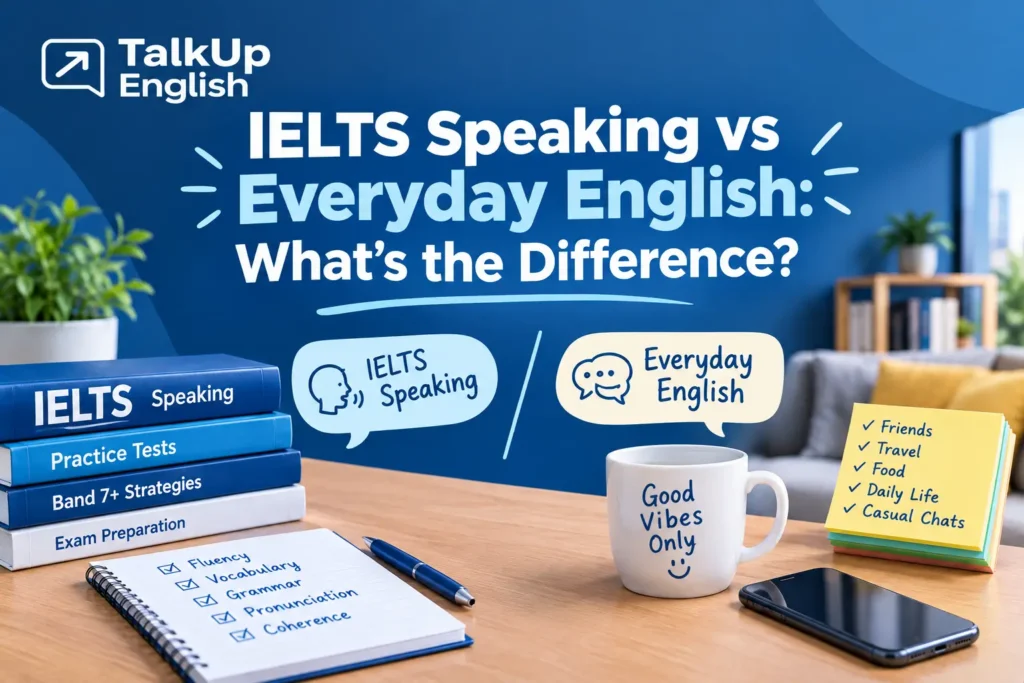
IELTS speaking and everyday English share the same language, but you use them for different purposes clearly. Everyday English helps you communicate naturally with friends, colleagues, service staff, and other people. IELTS Speaking measures your ability to communicate clearly and effectively under defined assessment criteria. You still need natural communication, but you must demonstrate controlled grammar, flexible vocabulary, clear pronunciation, and well-developed answers within a structured interview. Understanding the difference helps you prepare without memorising artificial responses. Talkup English can help you build practical communication skills while you develop the control required for an English proficiency exam.
What Is Everyday English?
Everyday English is the language you use for ordinary communication. You use everyday English when you greet someone, discuss plans, ask for information, explain a problem, share an opinion, or participate in workplace conversation. The language can be informal, concise, incomplete, or highly contextual because the listener often understands your meaning from the situation.
Everyday communication can include contractions, phrasal verbs, common expressions, repetition, fillers, and informal vocabulary. For example, you might say, “I’m pretty tired today,” “Can you give me a hand?” or “I’m not sure, but I think so.” These forms are normal when the situation supports them.
Everyday English does not require every sentence to demonstrate advanced vocabulary or complex grammar. Effective communication depends on clarity, appropriate word choice, listening ability, pronunciation, and the ability to respond quickly. You can communicate successfully without producing perfectly structured sentences.
What Is IELTS Speaking?
IELTS Speaking is a structured assessment of your spoken English. The International English Language Testing System (IELTS) Speaking test evaluates how effectively you communicate during a face-to-face interview with an examiner. The test contains three parts and assesses four criteria: fluency and coherence, lexical resource, grammatical range and accuracy, and pronunciation.
IELTS Speaking does not require you to speak like a lecturer or deliver a memorised speech. The examiner asks questions and gives you opportunities to respond, explain, describe, compare, and discuss ideas. Your responses need to remain relevant and sufficiently developed.
The assessment creates a controlled environment. You cannot choose every topic, restart an answer whenever you want, or rely on a familiar conversation partner. Your performance must show how well you can use English spontaneously while responding to unfamiliar or changing questions.
IELTS Speaking vs Everyday English: Key Differences
The biggest difference between IELTS speaking vs everyday English is the purpose and assessment environment. Everyday English focuses on successful communication, while IELTS Speaking requires you to demonstrate specific language abilities against published scoring criteria.
| Feature | IELTS Speaking | Everyday English |
| Purpose | Demonstrate English proficiency | Communicate in real situations |
| Setting | Structured examiner interview | Flexible social or professional interaction |
| Grammar | Accuracy and range are assessed | Minor errors may not prevent communication |
| Vocabulary | Range, precision, and appropriacy matter | Common and context-specific vocabulary is common |
| Fluency | Sustained, coherent responses matter | Natural pace varies by situation |
| Pronunciation | Clarity and intelligibility are assessed | Pronunciation varies across speakers and accents |
| Response style | Relevant, developed answers | Often brief, spontaneous, and context-dependent |
| Feedback | Formal band score | Usually informal or immediate |
| Pressure | Fixed test conditions | Depends on the situation |
The table shows why strong everyday communication does not automatically produce a high IELTS band score. IELTS Speaking measures performance under assessment conditions, while everyday English allows greater flexibility.
Does IELTS Speaking Require Formal English?
No. IELTS Speaking does not require you to use formal academic English in every response. You need natural, appropriate spoken English that demonstrates the four assessment criteria.
A common mistake involves treating IELTS Speaking like an academic essay. You do not need to avoid every contraction, use complicated words in every sentence, or deliver rigid introductions. In a conversational question, a response such as “Yeah, I do, because I spend a lot of time outdoors” can be completely appropriate.
The examiner assesses how effectively you communicate rather than whether your speech sounds unusually formal. Formal vocabulary can become a problem when you use words that do not fit the context or when memorised phrases make your response sound unnatural.
For Part 3 questions, your answers may need more explanation and analysis. You can express opinions, give reasons, discuss effects, compare perspectives, and provide examples. The language should remain natural while the ideas become more developed.
How Grammar Differs in IELTS Speaking and Everyday English
IELTS Speaking places greater pressure on grammatical accuracy and range. Everyday conversations often tolerate minor errors when the intended meaning remains clear.
For example, a person might say, “Yesterday I go to the market,” during a fast informal conversation. The listener may understand the intended meaning immediately. In IELTS Speaking, repeated tense errors can affect the grammatical range and accuracy score.
You should not interpret this difference as a requirement for perfect grammar. IELTS scoring recognises communication across different levels of proficiency. Your goal is to use accurate basic structures consistently and add more complex structures accurately when appropriate.
A useful practice method involves recording answers to common IELTS topics and checking tense control, subject-verb agreement, articles, prepositions, sentence boundaries, and complex sentence formation. Correct recurring errors instead of attempting to eliminate every minor mistake at once.
How Vocabulary Differs
Everyday English often relies on familiar words, phrasal verbs, idioms, contractions, and expressions that speakers use repeatedly. IELTS Speaking requires a broader vocabulary range and accurate word selection for different topics.
Consider a response about exercise. Everyday English might include, “I like working out because it makes me feel good.” IELTS performance can benefit from more precise language such as, “I prefer regular exercise because it helps me maintain my energy levels and manage stress.”
The second response is not better simply because the vocabulary sounds more advanced. The important difference is precision and flexibility. A candidate needs to express ideas clearly without forcing uncommon words into the answer.
You can develop vocabulary through topic practice. Learn useful combinations such as “maintain a healthy lifestyle,” “meet social needs,” “reduce commuting time,” and “develop professional skills.” Practise each expression in several original sentences so vocabulary becomes usable rather than memorised.
How Pronunciation Differs
Pronunciation matters in both contexts, but IELTS Speaking evaluates pronunciation as part of the official scoring system. Everyday communication usually focuses on whether listeners can understand you.
IELTS pronunciation involves more than individual sounds. You need understandable speech, appropriate word stress, sentence stress, rhythm, connected speech, and intonation. A strong accent does not automatically lower your score. Pronunciation becomes a problem when features of speech regularly reduce intelligibility.
For everyday communication, you may speak faster with familiar people, reduce sounds, or use local pronunciation patterns. For IELTS, controlled pacing can help you maintain clarity while you organise ideas. Speaking too quickly does not demonstrate fluency if pronunciation becomes difficult to understand.
How Fluency Differs
Fluency in everyday English means responding naturally and keeping communication moving. IELTS Speaking evaluates fluency and coherence through your ability to speak at length, organise ideas, use appropriate discourse features, and avoid excessive hesitation or repetition.
Some hesitation is normal. You may pause to think, correct yourself, or choose a word. The problem occurs when pauses, repetition, or false starts repeatedly interrupt communication.
Everyday conversations provide contextual support. A friend may finish your sentence, ask a simpler question, or understand your intended meaning from previous interactions. IELTS requires you to manage your own response and make your ideas sufficiently clear for an unfamiliar listener.
Why Everyday English Practice Helps IELTS Speaking
Yes. Everyday English practice can improve several skills that IELTS Speaking measures. Regular conversation develops faster retrieval of vocabulary, better listening-response coordination, more natural pronunciation, and greater confidence when you speak without preparation.
However, everyday practice does not replace IELTS-specific preparation. A conversation with a friend may not require you to extend an answer, justify an opinion, compare alternatives, or respond to abstract Part 3 questions.
Use everyday communication as a foundation, then add targeted IELTS practice. Discuss ordinary topics in English, record short responses, and practise extending answers with reasons and examples. Next, use IELTS-style questions to train under conditions that resemble the test.
Common Mistakes When Moving from Everyday English to IELTS
Several habits can limit IELTS Speaking performance when you transfer casual communication directly into the test.
The first mistake is excessive use of fillers such as “like,” “you know,” and “um.” Natural fillers occur in speech, but repeated fillers can interrupt fluency.
The second mistake is giving answers that are too short. Everyday questions often need short replies, while IELTS questions may require explanation or development.
The third mistake is forcing advanced vocabulary. Unfamiliar words can cause inaccurate usage and make speech less natural.
The fourth mistake is memorising complete answers. Memorised responses can become difficult to adapt when the examiner changes the question.
The fifth mistake is ignoring pronunciation because friends understand you. IELTS requires consistent intelligibility across the speaking test.
The sixth mistake is treating IELTS Speaking like IELTS Writing. Spoken answers should remain conversational and responsive rather than sounding like prepared essays.
How to Practise Everyday English for IELTS
To connect everyday English with IELTS preparation, create practice activities that require spontaneous communication and structured development.
Start with daily conversations. Explain your routine, discuss a recent experience, describe a problem, or give an opinion without translating from your first language.
Next, extend short answers. If a question produces “Yes, I like travelling,” add a reason and a relevant example: “Yes, I like travelling because I enjoy experiencing different cultures. Last year, I visited a city where I tried several local foods.”
Record two-minute responses and review pronunciation, pauses, grammar, vocabulary, and idea development. Do not judge every sentence separately. Look for repeated patterns that affect overall clarity.
You can then practise with a partner or a private English tutor who can identify errors that you may not notice alone. Targeted feedback helps you convert passive knowledge into usable speaking skill.
IELTS Speaking and Everyday English Can Work Together
IELTS Speaking and everyday English do not represent two separate forms of English. Both require the same core language system, but each context creates different communication demands.
Everyday English helps you build spontaneous communication, listening-response speed, practical vocabulary, and confidence. IELTS preparation adds structured practice, assessment awareness, answer development, and targeted correction.
The most effective preparation connects both forms of practice. Use English in real conversations instead of relying only on worksheets, then practise IELTS questions to understand how exam conditions affect your performance. This approach helps you avoid memorised language while developing the specific skills required for the test.
If you already communicate comfortably and want to develop more advanced control, an advanced level English course can help you practise more complex language while maintaining accuracy and natural delivery.
Frequently Asked Questions
What is the difference between IELTS speaking and everyday English?
IELTS Speaking assesses your spoken English against defined criteria, while everyday English supports natural communication in ordinary situations. IELTS evaluates fluency, vocabulary, grammar, and pronunciation under controlled test conditions, whereas everyday conversation allows greater flexibility, contextual support, informal language, and shorter responses.
Is IELTS speaking harder than everyday English?
IELTS Speaking is more structured and demanding in specific ways, but difficulty depends on your language level and experience. The test requires sustained responses, grammatical control, vocabulary range, pronunciation, and relevance, while everyday communication can succeed despite minor errors or incomplete sentences.
Can everyday English help improve IELTS speaking skills?
Yes, everyday English practice can improve IELTS Speaking skills by developing fluency, vocabulary retrieval, pronunciation, listening-response speed, and confidence. However, everyday conversation does not fully prepare you for IELTS task conditions, so targeted practice remains necessary for response development and assessment criteria.
Can I improve my IELTS speaking score through everyday English practice?
Yes, everyday English practice can contribute to IELTS Speaking improvement when practice develops accurate, clear, and spontaneous communication. You can strengthen vocabulary, pronunciation, fluency, and confidence through real conversations, then combine those skills with IELTS questions, feedback, and structured performance practice.