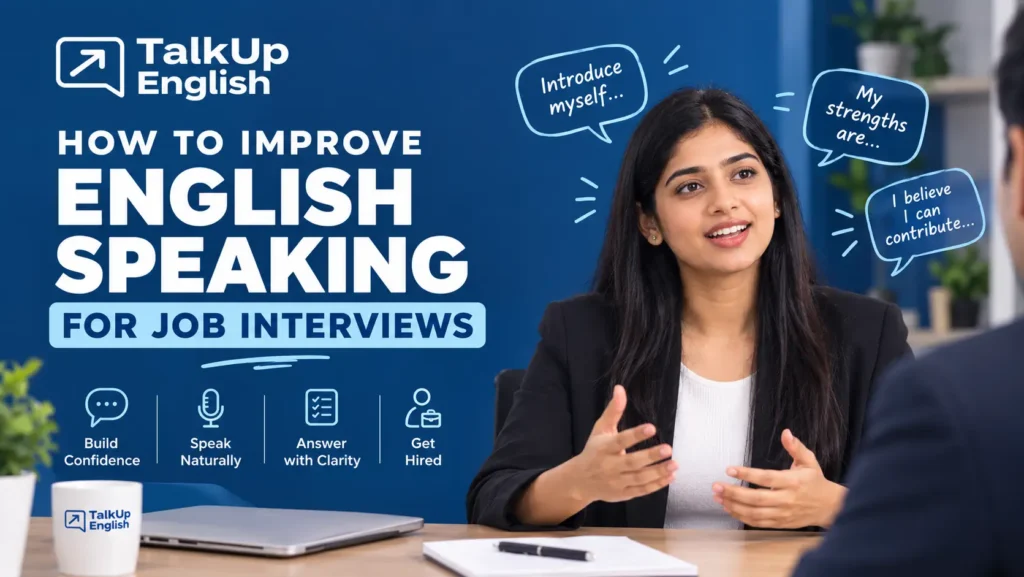
A job interview tests more than qualifications. Your English speaking skills affect how clearly you explain experience, answer questions, discuss achievements, and respond to the interviewer. Strong interview English does not require complicated vocabulary or a native accent. You need clear pronunciation, accurate grammar, relevant vocabulary, controlled pace, and regular spoken practice.
The most effective approach combines preparation with practice. Learn job-specific language, prepare concise answers, rehearse common questions aloud, and practice asking professional questions.
Why Is English Speaking Important in a Job Interview?
Yes, clear English speaking is important because an interviewer needs to understand your experience, skills, reasoning, and communication style. Strong speaking performance helps you present relevant information without confusion and respond directly to questions.
Clear language works better than vocabulary that you cannot use accurately. Your goal is to communicate ideas precisely, maintain a professional tone, and show effective workplace communication.
Prepare Your English Before the Interview
To prepare your English, study the job description, company information, and responsibilities before practicing answers. Identify the vocabulary that appears in the position description, then connect that vocabulary with your actual skills and experience.
Write short answers to predictable questions, but do not memorize complete paragraphs. Memorization can make your speech sound unnatural and can cause problems when an interviewer asks the question differently. Prepare ideas, examples, and useful phrases instead.
Research the company and position so your answers contain specific details. A strong response to “Why do you want this job?” can connect the company’s work with your professional goals and relevant experience.
Practice the Most Common Interview Questions
To practice effectively, prepare answers for the questions most likely to appear in your interview. Focus on meaning, structure, pronunciation, and timing rather than memorizing exact wording.
Common questions include:
- Tell me about yourself.
- Why do you want this job?
- Why do you want to work for our company?
- What are your greatest strengths?
- What is one weakness you are improving?
- What relevant experience do you have?
- Tell me about a difficult challenge at work.
- Describe a successful project you completed.
- How do you handle pressure?
- Where do you see yourself in five years?
Build each answer around your professional background and the requirements of the position. A useful introduction can include your current role, years of experience, strongest relevant skill, and reason for applying. Keep the answer focused rather than providing unrelated personal history.
Use the STAR Method for Behavioral Questions
Yes, the STAR method can make behavioral answers clearer because the method gives your response a logical structure: Situation, Task, Action, and Result.
Start with the Situation by explaining the relevant workplace context. State the Task by identifying your responsibility or objective. Describe the Action by explaining what you personally did. Finish with the Result by giving the measurable or practical outcome.
For example, if an interviewer asks about a difficult project, explain the project problem, your assigned responsibility, the specific actions you took, and what changed after your actions. Use “I” when describing your contribution so the interviewer can distinguish your work from the team’s overall work.
Avoid spending most of the answer on background information. The Action and Result sections should demonstrate your decision-making, communication, problem-solving, and professional skills.
Speak Clearly and at a Controlled Pace
To speak clearly, use a comfortable pace, pronounce important words fully, and pause briefly between ideas. Speaking too quickly can reduce pronunciation clarity and make accurate grammar harder to produce.
A short pause gives you time to organize the next sentence and prevents filler words such as “um,” “uh,” “like,” and “you know.” Replace filler words with silence rather than forcing yourself to speak continuously.
Practice difficult terms from the job description aloud. Record your voice and listen for unclear sounds, repeated words, unfinished sentences, and sudden changes in speaking speed. Repeat the same answer after correcting one issue at a time.
Do not try to change your accent completely before an interview. Focus on intelligibility, consistent pronunciation, word stress, and clear sentence endings. The interviewer needs to understand your message easily.
Improve Your Interview Vocabulary
To improve interview vocabulary, learn professional words that accurately describe your experience instead of collecting complicated expressions. Useful categories include responsibilities, achievements, teamwork, leadership, problem-solving, communication, organization, and professional development.
Replace vague statements with specific language. Instead of saying, “I did many things,” explain the responsibility. Instead of saying, “The project was good,” describe the outcome, such as faster delivery, fewer errors, improved customer satisfaction, or successful completion.
Use verbs that show action and ownership, such as managed, coordinated, developed, analyzed, resolved, organized, implemented, improved, supported, trained, and delivered. Select verbs that accurately represent what you did.
Practice complete phrases rather than isolated vocabulary. Useful expressions include “In my previous role,” “My main responsibility was,” and “One example is.”
Use Clear and Simple English
Yes, simple English is appropriate for professional interviews because clarity allows the interviewer to understand your meaning quickly. Complex vocabulary does not automatically demonstrate stronger communication.
Choose words that you can pronounce and use accurately. Keep sentences reasonably short when explaining technical information. Define specialized terms when necessary.
Avoid slang, unnecessary idioms, and expressions copied from sample answers. Natural professional English is more effective than language that does not match your normal speaking ability.
Use specific details when they strengthen an answer. If you describe a successful project, mention your responsibility, the action you took, and the outcome. Concrete information makes your response easier to understand and evaluate.
Reduce Hesitation Without Memorizing Scripts
To reduce hesitation, practice answering questions from keywords rather than reading prepared sentences. Write three to five prompts for each answer and speak from those prompts.
For example, an answer about a previous role might use the prompts “three years,” “customer support,” “team coordination,” “process improvement,” and “promotion.” The prompts remind you of the content while allowing natural sentence construction.
Use controlled pauses when you need time to think. Professional phrases can help you manage the conversation, such as “That is a good question,” “Let me think about that,” or “In my experience, the main issue was…”
If you do not understand a question, ask for clarification. You can say, “Could you please repeat the question?” or “Could you clarify what you mean by that?” Asking for clarification is better than answering a different question.
Practice Active Listening
To improve interview communication, practice listening as carefully as speaking. Listen for the question’s main purpose, important keywords, and any limits placed on the answer.
Do not prepare your next sentence while the interviewer is still speaking. Wait until the interviewer finishes, then identify the central question before responding. This habit reduces irrelevant answers and helps you respond more directly.
Watch for follow-up questions. An interviewer may ask for a specific example after a general answer. Prepare to explain your experience with additional details without repeating the original response.
Use Professional Phrases During the Interview
Professional phrases help you manage common interview situations naturally. At the beginning, use expressions such as “Good morning,” “Nice to meet you,” and “Thank you for the opportunity.”
When answering, phrases such as “In my previous role,” “One example is,” and “The main result was” can provide structure. When you need time, use “Let me think about that” rather than a series of filler sounds.
When you disagree or need clarification, remain polite. You can say, “Could you clarify that point?” or “Could you explain what you mean by that requirement?” At the end, say, “Thank you for your time. I look forward to hearing from you.”
These phrases should support genuine communication rather than replace meaningful answers.
Ask Questions in English at the End
Yes, asking relevant questions demonstrates preparation and gives you an opportunity to understand the position better. Prepare three or four questions, then select questions that the interviewer has not already answered.
Useful questions include:
- What would success look like in this position during the first six months?
- What are the main priorities for this role?
- How does the team collaborate on projects?
- What are the next steps in the interview process?
Avoid questions that the company website or job description already answers. Listen during the interview so your final questions respond to information discussed during the conversation.
Practice English Speaking at Home
To practice at home, create a short daily speaking routine that combines preparation, repetition, recording, and correction. Spend 10 minutes answering interview questions aloud, 10 minutes reviewing vocabulary, and 10 minutes listening to your recording or practicing with another person.
You can use a timer to keep answers focused. Aim for approximately one to two minutes for standard questions, while behavioral questions may require more time because you need to explain the Situation, Task, Action, and Result.
If you want guided speaking practice, an English tutor online can provide conversation practice, pronunciation correction, interview role-play, and targeted feedback.
Use Mock Interviews to Build Fluency
To develop interview fluency, complete realistic mock interviews before the actual interview. Ask a friend, teacher, or language tutor to act as the interviewer without giving you answers in advance.
Record the session when possible. Review relevance, pronunciation, filler words, and whether your examples contain enough specific detail. Repeat the mock interview after correcting the most important problems.
Prepare for Online English Interviews
For online interviews, test your microphone, camera, internet connection, and interview platform before the meeting. Choose a quiet location and keep your face clearly visible.
Keep notes nearby, but avoid reading full answers. Use short prompts with keywords, examples, and questions. If the connection interrupts the conversation, politely confirm the question before answering.
Final Interview Preparation Checklist
Before the interview, confirm that you can introduce yourself clearly, explain relevant experience, describe two or three strengths, discuss one weakness and your improvement plan, and provide several STAR examples.
Review the company, position, responsibilities, and vocabulary. Practice aloud, prepare questions, and rehearse clarification phrases. Review examples and confirm every answer stays relevant, concise, specific, and easy for the interviewer to follow.
On interview day, focus on understanding each question before answering. Speak clearly, use concise sentences, pause when necessary, and keep your answers connected to the position. Strong English speaking for job interviews comes from preparation, practice, active listening, and controlled delivery.
Frequently Asked Questions
How can I improve my English speaking skills for a job interview?
Practice aloud every day with realistic interview questions, record your answers, and correct pronunciation, grammar, filler words, and pacing. Use job-specific vocabulary and mock interviews so your English speaking becomes controlled, natural, and responsive under pressure.
What are the most common English interview questions and answers?
Common questions cover your background, motivation, strengths, weaknesses, experience, challenges, and career goals. Prepare concise answers for “Tell me about yourself,” “Why do you want this job?” and behavioral questions, using specific professional examples to support relevant claims.
How can I introduce myself confidently in an English interview?
Introduce yourself with your current role, relevant experience, strongest professional skill, and reason for applying. Keep the introduction concise, speak clearly, and connect your background directly to the position rather than providing unrelated personal information.
How can I answer job interview questions in English without hesitation?
Use keyword prompts instead of memorized scripts and practice answering aloud under timed conditions. Pause before difficult answers, use “Let me think about that,” and ask for clarification directly when the interviewer’s question is unclear.
What English phrases should I use during a job interview?
Use professional phrases to greet the interviewer, structure answers, request clarification, and close the conversation. Examples include “Thank you for the opportunity,” “In my previous role,” “Could you clarify the question?” and “I look forward to hearing from you.”
How can I practice speaking English for job interviews at home?
Practice with recorded mock interviews, timed answers, pronunciation drills, and job-specific vocabulary. Spend 30 minutes daily speaking aloud, reviewing recordings daily, correcting repeated errors, and answering unfamiliar questions from keywords rather than reading prepared responses.