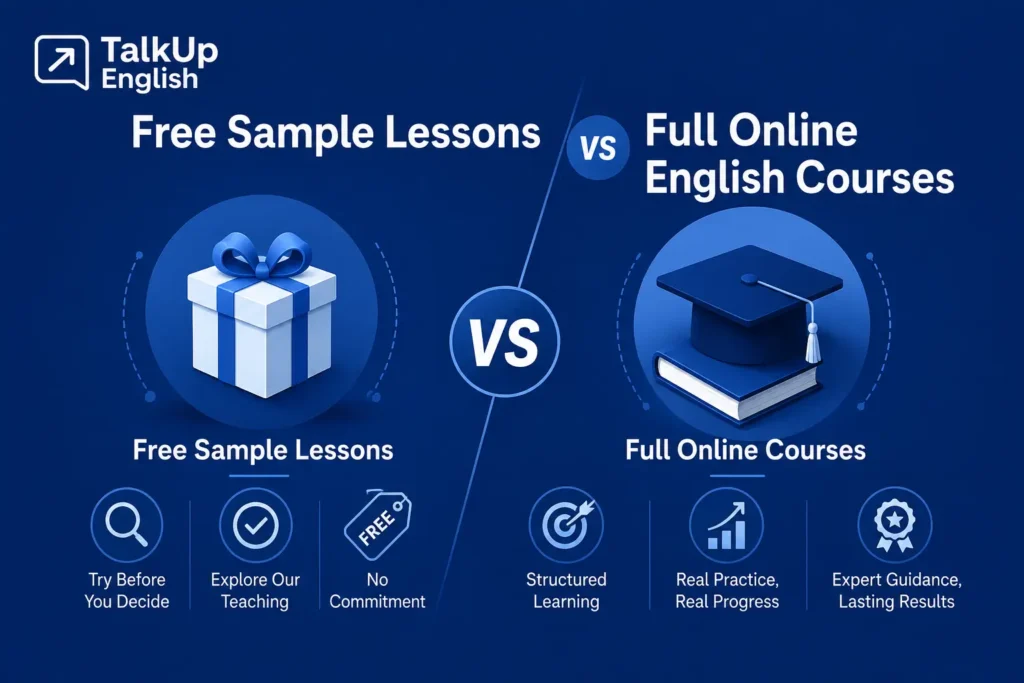
Free sample English lessons vs full course options serve different learning needs. Free lessons help you test teaching styles, review specific topics, and decide whether an online learning platform suits you. A full course provides a structured curriculum, regular practice, and a clear path toward your English goals. The right choice depends on your current level, target skills, budget, and need for feedback.
You do not always need to pay to learn English. Free resources can support reading, listening, beginner vocabulary, and basic grammar. However, speaking and writing often require expert feedback that independent practice cannot provide. Understanding the difference helps you spend money where it delivers real value and avoid subscriptions that add little to your progress.
What Are Free Sample English Lessons?
Free sample English lessons are short learning sessions that let you test a course, teacher, or topic without paying. A sample may cover one grammar rule, a short conversation, a pronunciation exercise, or a specific vocabulary set.
Free lessons are particularly useful when you need to solve one immediate problem. For example, you can review articles, practise common phrasal verbs, or learn useful phrases for a job interview. However, separate lessons rarely provide a complete learning roadmap. You may understand one topic without knowing what to study next or how to apply the skill in a real conversation.
What Does a Full Online English Course Include?
A full online English course follows a planned sequence of lessons that builds your skills from one level to the next. The course usually starts with an assessment or level recommendation, then progresses through connected modules with practice and revision.
A comprehensive course may include:
- Speaking: Conversation tasks, pronunciation practice, and guided responses.
- Listening: Exercises that develop comprehension across different contexts and accents.
- Reading: Texts that build understanding, vocabulary, and sentence awareness.
- Writing: Tasks that help you create clear messages, paragraphs, and professional emails.
- Grammar and vocabulary: Lessons that explain language rules and show how to use words accurately.
- Assessment and feedback: Quizzes, corrections, progress reviews, or teacher guidance.
Course features vary, so check the syllabus before enrolling. Some courses provide recorded lessons and automated quizzes, while others include live teaching and individual feedback. A higher price does not automatically guarantee better teaching or faster results.
Free Sample Lessons vs Full Course: Key Differences
The main difference is purpose. A sample helps you evaluate or practise a limited topic, while a full course provides a sequence designed around broader learning outcomes.
Factor | Free sample lessons | Full online course |
| Cost | No initial payment | Subscription or one-time fee |
| Structure | Usually standalone | Planned lesson sequence |
| Skill coverage | One topic or selected skills | Multiple skills and levels |
| Feedback | Often limited or unavailable | May include teacher corrections |
| Progress tracking | Usually minimal | May include tests and reviews |
| Best use | Testing and quick revision | Consistent, long-term development |
Choose a sample when you want to inspect the teaching approach before making a financial commitment. Choose a full course when you need a study plan, connected lessons, and consistent practice toward a defined target.
Where Free English Lessons Offer the Best Value
Free English resources work especially well for reading, listening, beginner vocabulary, and basic grammar. These skills allow substantial independent practice because you can access large amounts of written and recorded material without paying for a course.
For reading, public-domain books, accessible articles, and Wikipedia pages expose you to sentence structures and new vocabulary. Project Gutenberg offers public-domain books that you can read without a paid subscription. Select material that matches your ability so you can understand the main points without checking every word.
For listening, podcasts, educational videos, interviews, and audiobook samples provide regular exposure to spoken English. Choose content you enjoy and replay short sections when you miss important details. Transcripts can help you connect spoken words with written forms.
Free vocabulary tools and grammar websites can support beginner study. Anki flashcards help you review words at planned intervals, while BBC Learning English and British Council learning resources offer grammar explanations and practical exercises. Free lessons can therefore form a substantial part of your study routine.
Where Free Lessons Fall Short
Free lessons often fall short when you need individual speaking feedback, detailed writing corrections, or a complete learning sequence. Watching a conversation video may help you understand useful phrases, but passive exposure cannot confirm whether your pronunciation, grammar, and responses work in real conversations.
Solo speaking practice remains useful. You can read aloud, record yourself, repeat short audio passages through shadowing, and compare your speech with a reliable example. These methods help you notice pauses and pronunciation problems. However, you may not recognise unnatural phrasing or errors that require a teacher’s explanation.
You do not necessarily need an expensive subscription to receive this support. A small number of targeted sessions with a qualified tutor may provide more useful feedback than several overlapping apps. Pay for the help that addresses your actual weakness rather than paying for features you rarely use.
Is a Full English Course Worth Paying For?
A full course is worth paying for when you need structured lessons, measurable progress, and support that free resources cannot provide. A course can reduce the time you spend deciding what to study and help you move through topics in a logical order.
Paid learning is especially useful in three situations.
You have a specific deadline. A job interview, university application, or language examination may require focused preparation. An intensive course or tutor can help you prioritise relevant skills, although results depend on your starting level, study time, and practice quality.
You need English for a specialised purpose. Business English, legal English, medical English, and IELTS Academic preparation require task-specific vocabulary, communication practice, or assessment criteria. A targeted course can provide relevant exercises that general free lessons may not cover in sufficient depth.
How to Build a Cost-Effective English Learning Plan
Combine free study resources with paid instruction only where expert feedback adds clear value. This approach helps you control costs without neglecting speaking or writing.
Use a simple weekly plan:
- Vocabulary: Review useful words with flashcards and create original example sentences.
- Grammar: Study one topic, complete exercises, and correct your mistakes.
- Reading: Read a short article or graded text suited to your level.
- Listening: Follow a podcast or video and summarise the main points aloud.
- Speaking: Practise conversations, record short responses, or schedule a tutor session.
- Writing: Draft a message or paragraph and seek feedback when accuracy or tone matters.
Review your progress each week. Check whether you understand more of your listening material, use new vocabulary correctly, write clearer sentences, and speak with fewer avoidable pauses. If progress stalls, identify the specific skill that needs support before purchasing another tool.
How to Choose Between a Sample and a Full Course
Start with a free sample when you are unsure about the teacher, course level, lesson format, or value. Use the sample to check whether explanations are clear, exercises are relevant, and the difficulty matches your ability.
After the lesson, ask yourself three questions: Did you understand the main concept? Could you apply the lesson without copying the example? Does the course address your real learning goal? If the answers are unclear, try another sample before paying.
Start Your Online English Course for Beginners
If you are starting to learn English or need to strengthen your basic grammar, vocabulary, and everyday communication skills, a structured beginner course can give you a clear learning path. Guided lessons help you build essential language skills step by step and prepare you for more advanced topics.
Explore the English course for beginners to review the course content and check whether the lessons match your current level and learning goals.
Try Free English Sample Lessons Online
If you want to assess an online English learning platform before purchasing a full course, free sample lessons let you explore the teaching style, lesson structure, and difficulty level without an initial financial commitment. Use the samples to identify whether the explanations and exercises suit your learning preferences.
Explore the free English language lessons to try sample content and decide whether the learning approach supports your English goals.
Frequently Asked Questions
What is the difference between free sample English lessons and a full course?
Free sample lessons introduce a topic or teaching style, while a full course follows a structured curriculum. Samples help you test suitability without cost. Full courses usually offer broader skill coverage, planned progression, and more opportunities for assessment, practice, and feedback.
Are free sample English lessons enough to improve speaking skills?
Free sample lessons can help you learn phrases and practise pronunciation, but samples alone rarely build confident speaking. Regular conversation, corrective feedback, and repeated practice help you recognise errors and respond naturally. Use free lessons as a starting point, not your only speaking method.
Is a full English course worth paying for?
Yes, a full English course is worth paying for when structured lessons and expert feedback support a clear goal. Compare the curriculum, teacher qualifications, practice tasks, and total cost before enrolling. Pay for useful support rather than features you will not use.
Should beginners try a free English lesson before joining a full course?
Yes, beginners should try a free lesson when a sample is available. A short session helps you assess the teaching style, lesson difficulty, and platform usability before paying. Choose a complete beginner course afterward if you need a guided sequence from basic grammar to conversation.
Do full English courses offer better results than free lessons?
Full courses can deliver better results when learners need structure, regular assessment, and individual feedback. Free resources can be equally useful for independent reading, listening, and basic grammar practice. Results depend on course quality, learner consistency, current ability, and the skills being developed.